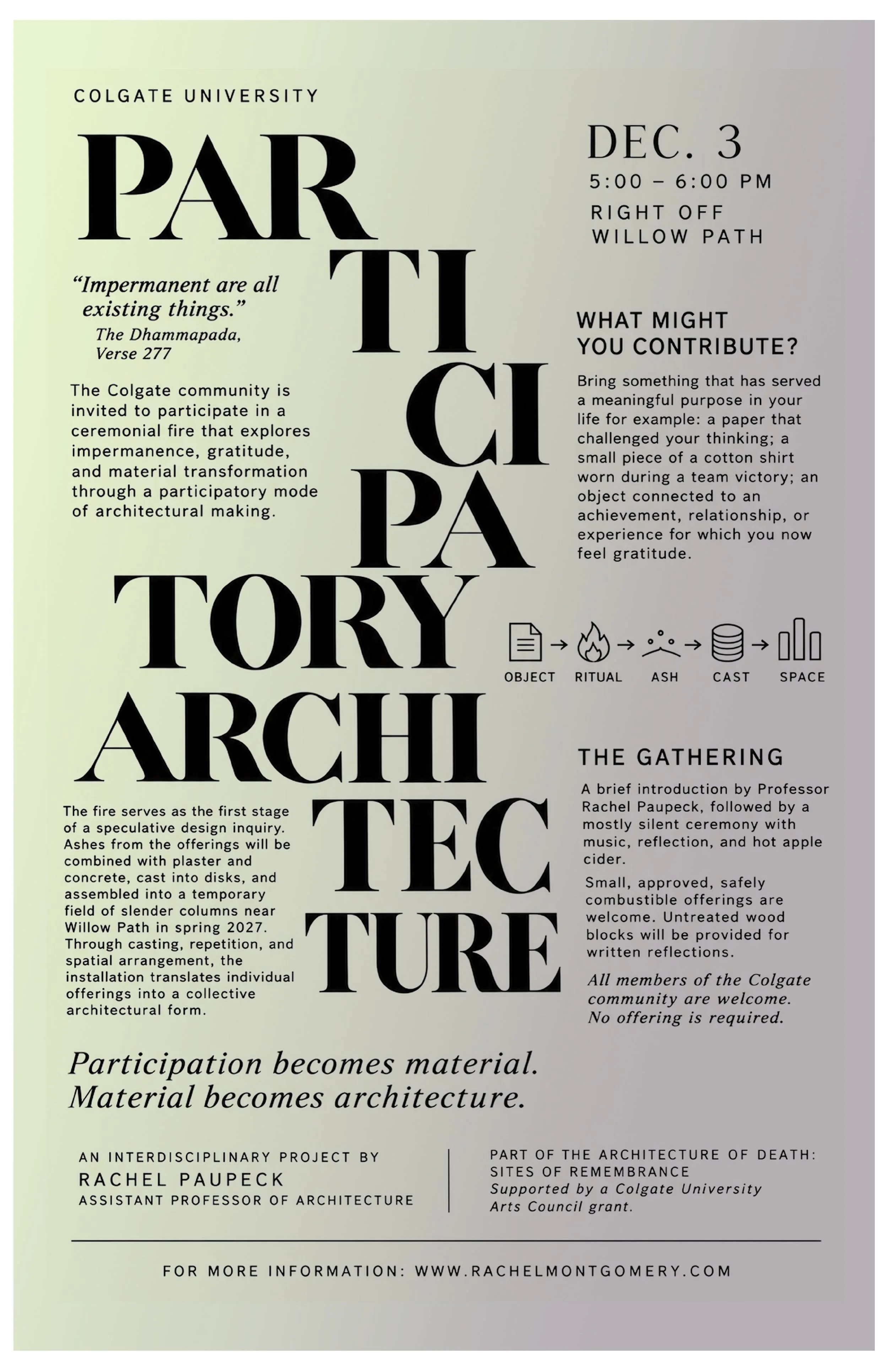
Participatory Architecture | Community Fire
Who contributes to the making of a memorial? How does participation become material, and how does that material become architecture—in this case, a collective architecture?
Rachel Paupeck, Assistant Professor of Architecture, invites the Colgate community to take part in the first stage of Participatory Architecture: The Architecture of Memory, a temporary memorial to be installed near Willow Path in spring 2027.
At the center of this project is a question of architectural authorship: Who makes architecture, and how might a community participate in making the very material from which it is built? The project considers how objects tied to personal experiences can acquire collective significance through ritual, casting, and their placement in the landscape.
Participants are invited to bring a small, non-toxic, safely combustible offering connected to an experience of personal significance—perhaps a paper that changed how they think or a scrap of cotton from a shirt worn during a team victory. Offerings must contain no plastics, metals, or toxic materials. Untreated wood blocks will also be available for written reflections.
In a series of casting workshops in spring 2027, participants will mix ash collected from the fire into a plaster and concrete composite and cast it into disks. Through this process, the material traces of individual experiences become part of a collective architectural form.
The disks will be stacked into slender columns and installed near Taylor Lake. Echoing the vertical forms and irregular spacing of the surrounding trees, the columns blur the boundary between architecture and landscape. As visitors move along the path, the shifting relationships between the columns and trees make the landscape an active agent in how we experience, internalize, and hold memory. Remembrance becomes not simply something represented by architecture, but something experienced through movement, material, and our relationship to the landscape.
Paupeck will briefly introduce the project. The gathering will then continue primarily in silence, with music, time for reflection, and hot apple cider.
Open to all members of the Colgate community. No offering is required.
Part of The Architecture of Death: Sites of Remembrance, an interdisciplinary architectural research and public art project by Rachel Paupeck, supported by the Colgate University Arts Council.